
Architectural Soundscaping in Urban Public Spaces: Designing for Restorative Environments
Words by Annie Latimore, Nottingham Trent University
This research project investigates how sound can be intentionally incorporated into architectural design to create healthier and more restorative urban environments.
While architecture commonly prioritises visual qualities such as form, materiality and spatial composition, sound is an equally important part of how people experience and respond to their surroundings. The research explores how architectural and landscape interventions can influence the acoustic character of urban spaces and whether carefully designed soundscapes can contribute to greater comfort, tranquillity and psychological restoration.
The research was developed in response to the increasing pressures associated with urbanisation. Rather than approaching acoustic design solely as a process of controlling or reducing unwanted noise, the project investigates the potential to actively introduce positive sounds into the built environment. This shifts the role of acoustics from mitigation towards experience, considering sound as a design material capable of influencing how a space is perceived.
The study focused on three broad categories of sound. Anthrophonic sounds are generated by human activity and urban infrastructure, including traffic and movement. Biophonic sounds originate from living organisms, such as birds and insects, while geophonic sounds are produced by natural physical processes, particularly water. These categories provided a framework for investigating how different acoustic conditions might influence the restorative qualities of an urban environment.
A mixed-methods research approach was adopted, beginning with a review of existing literature surrounding soundscaping, restorative environments, biophilic design and the relationship between landscape characteristics and wellbeing. This established the theoretical foundation for the investigation and identified several architectural factors that could influence acoustic perception, including vegetation, water, spatial enclosure and visual connections with nature.
Four scenarios were developed to investigate the influence of different acoustic strategies. The first established an anthropophonic baseline, representing an urban environment dominated by sounds associated with human activity and infrastructure. The second introduced biophonic soundscaping, incorporating vegetation and wildlife sounds to investigate the effect of natural biological activity. The third focused on geophonic soundscaping, using water as a primary acoustic element. The final scenario combined biophonic and geophonic sounds with spatial enclosure and landscape interventions to explore the potential of a more comprehensive architectural soundscape.
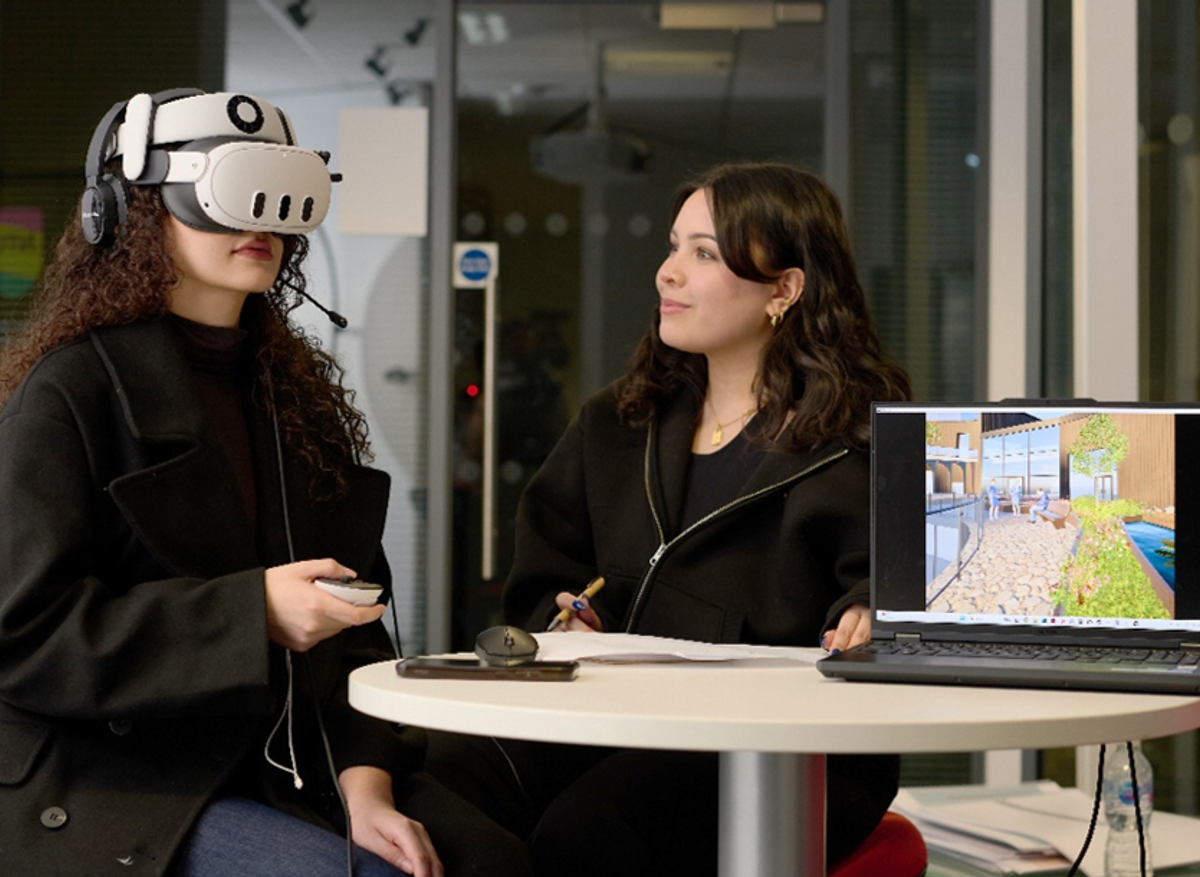
Virtual reality provided an important bridge between digital modelling and user experience, providing a more effective way of investigating how participants respond to the relationship between sound, space and landscape.
Ten participants who lived in urban environments took part in the evaluation. Each experienced the different scenarios before completing a questionnaire measuring perceived comfort, tranquility, stress reduction and overall restorative experience.
The results indicated a clear preference for environments incorporating natural sounds. The anthropophonic scenario consistently received the lowest responses, suggesting that an environment dominated by urban noise was perceived as less comfortable and restorative The findings support the proposition that natural sounds can positively influence the perceived restorative qualities of urban space.
The combined scenario produced particularly positive responses, demonstrating the potential benefit of integrating soundscape design with wider architectural and landscape strategies. The research suggests acoustic qualities can be reinforced through spatial enclosure, planting, water and visual connections to nature. This creates a more coherent sensory environment in which architecture, landscape and sound work together rather than functioning as independent design elements.
The research has particular relevance to healthcare environments, therapeutic landscapes and rehabilitation settings, where the relationship between environment and wellbeing is especially important. The approach also provides an opportunity for architectural technologists to consider environmental performance more holistically, extending beyond thermal, structural and visual considerations to include sensory experience.
Overall, the research demonstrates that sound can be treated as an active component of architectural design rather than simply an environmental condition to be controlled. The findings suggest that carefully designed combinations of biophonic and geophonic sounds, supported by landscape and spatial strategies, can contribute to more comfortable and restorative urban environments.
The project ultimately highlights the expanding role of architectural technology within research-led design. Through the use of digital simulation and immersive evaluation, technology becomes a means of understanding how people experience architecture, providing evidence that can inform future design decisions. Successful restorative environments should engage more than the visual senses, and by designing sound alongside space, architecture can make a meaningful contribution to the wellbeing of people living within increasingly urbanised environments.
-
A highly engaging and methodologically strong research investigation. There is a clear progression from the research problem through methodology, findings and discussion to an evidence-led conclusion. A worthy winner.
Judges' comments
Student Report of the Year