Virtual Campus, Ulster University
The Ulster University Virtual Campus Team
Words by The Ulster University Virtual Campus Team
Most people recognise the subtle anxiety that accompanies entering an unfamiliar environment, navigating new spaces and anticipating what comes
next. For many, the university environment represents exactly this challenge, a complex and often vast environment in both scale and sensory demands. For a neurodivergent individual, or those with specific or complex needs, these feelings can be exacerbated.
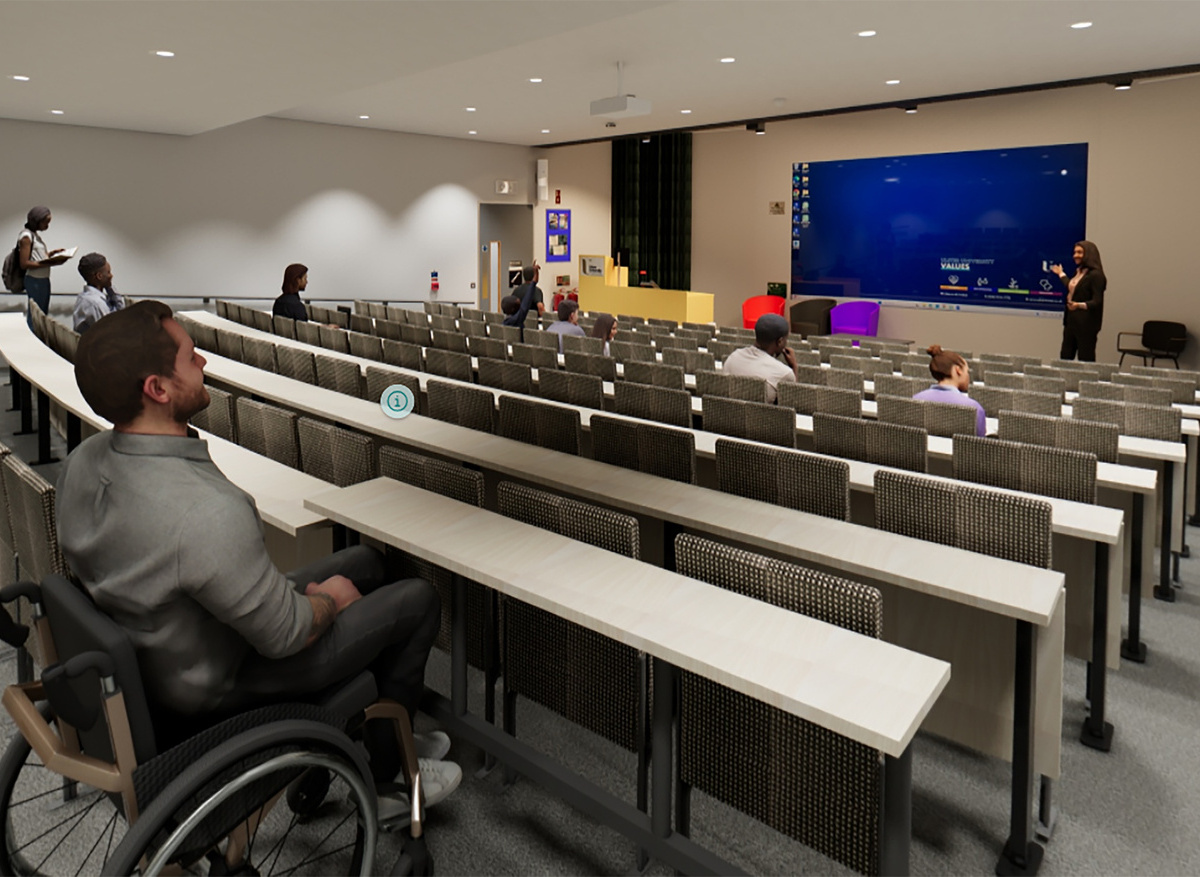
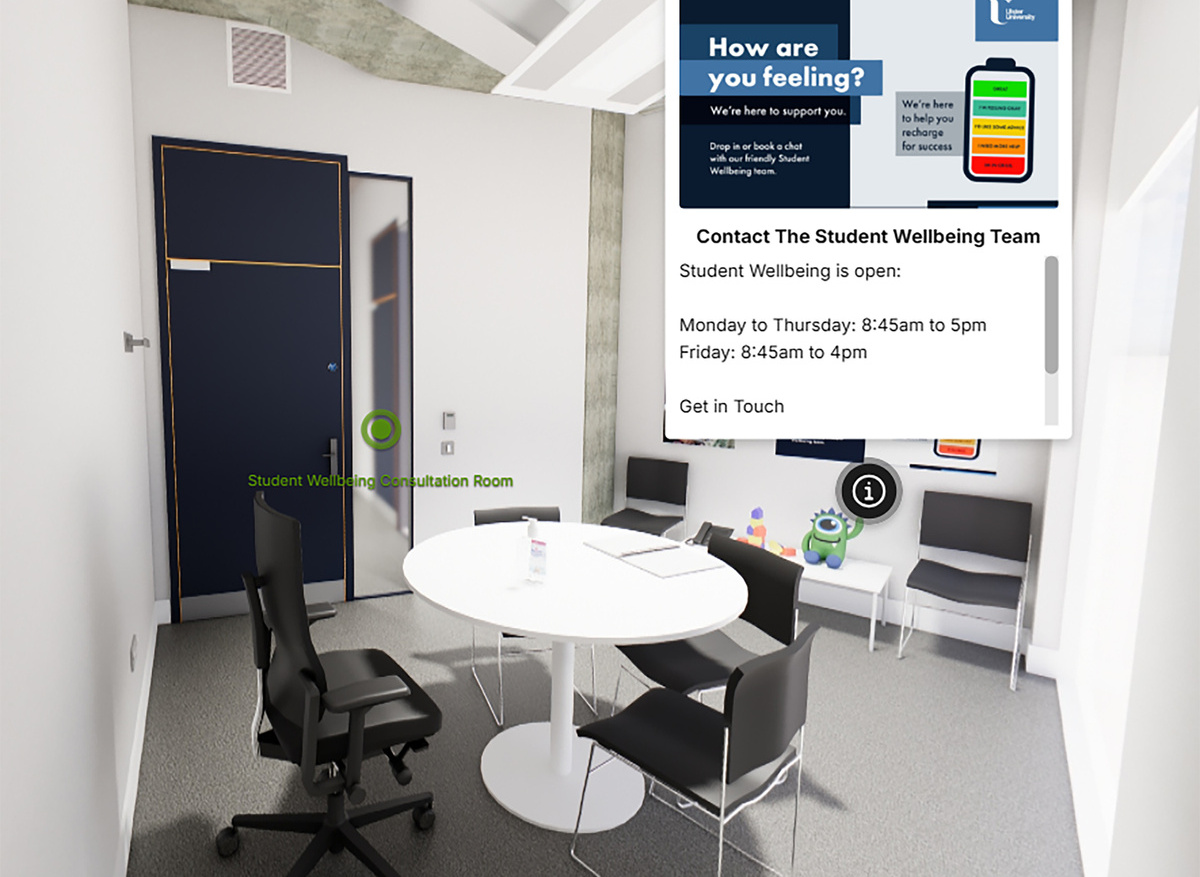
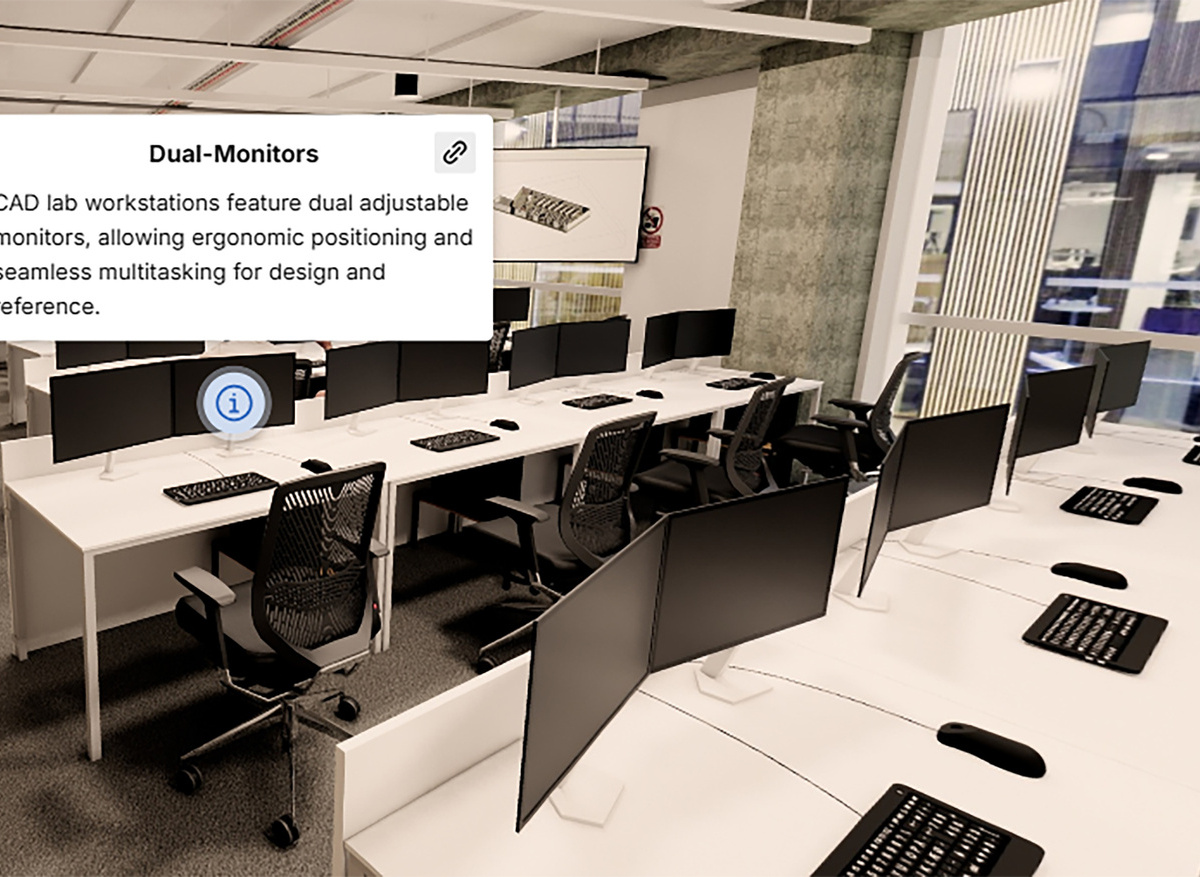
Virtual Campus was developed to respond to this challenge by delivering an immersive virtual experience to aid familiarisation with spaces across all Ulster University campus locations. This allows for early-stage intervention, develops a stronger sense of belonging, prepares for transition and generally empowers, reframing the campus experience from one of unpredictability to one of preparedness.
Virtual Campus is a multi-award winning initiative, allowing users to virtually explore and connect with Ulster University campus locations. It has become a permanent resource on the university webpage, hosting virtual outputs of Ulster University spaces, and having a significant impact on students, staff and visitors.
The ambition of Virtual Campus was to support the wellbeing of staff, students and visitors to Ulster University, especially mindful of vulnerable students’ wellbeing and anxiety around space familiarisation and transition. This was to be delivered in a format that would satisfy the digital native expectation of having immediate access to information, yet be widely accessible, and within the backdrop of the university undergoing a significant campus relocation.
Whilst obvious solutions existed around static images, videos, 360-degree imagery and 3D space capture solutions, the team wanted to be future-oriented, identifying the expectations of the next generation of learners and make the outputs immersive and memorable. This led the team to consider learning environments and metaverse-related outputs, along with potential opportunities to gamify spaces from the perspective of space familiarisation.
The team were also aware of the benefits of an output that would provide basic analytics on user behaviour, potentially aiding optimisation of the
experience, and identifying key areas around which to develop more content. Whilst the stated solutions had benefits, nothing identified fully aligned with these specific ambitions. It is within the backdrop of these challenges that Virtual Campus was developed.
The project was developed in two stages. The initial phase concentrated on the new Belfast Campus before the focus switched to other campus locations. For the new build Belfast campus, the team were granted access to the existing project models which drove the selection of the authoring platform used.
Firstly, key spaces were identified that would prove most beneficial to the target end users. Once the spaces were identified, laser scans were undertaken to compare the physical built spaces against the model, whilst also capturing the ‘as-built’ fit-out. The identified existing models were then updated where required, with bespoke families created for the virtual replicas.
A plug-in for the authoring platform was then used to create the high-quality visual and Virtual Reality (VR) outputs. It was felt that this workflow would allow the generation of outputs which would benefit the widest audience possible. Whilst the outputs allowed for viewing in VR using higher-end viewers, more importantly, it supported more affordable viewers required for this project to immerse the widest possible audience, along with the ability to view the outputs directly from the webpage on any screen or device. The workflow also helped enable the longer-term ambitions
to be achieved.
The second stage of the project saw spaces in other campus locations developed. A similar workflow was adopted, with the main difference being that as there were no existing models, all the spaces had to be fully developed by the team. The continued evolution has seen the focus shift from VR outputs to web hosted screen content with information points and signposting to convey key information even if individuals don’t physically visit. The output generated has achieved the objective of being easily customised and has also enabled content to be used as a learning resource.
The beauty of this project is its simplicity, using a workflow which is transferable and can be replicated by others to reduce anxiety around space familiarisation and enhance wellbeing.
Virtual Campus is distinguished by its student-driven ethos, empowering ATM placement students to help shape and evolve the platform, with the majority of the Virtual Campus webpage outputs to date solely developed by these students. The initial and subsequent work has inspired student research projects, some of which have been award winning. Evidence of impact is the over 95,000 active users, with visitors from approx. 140 different countries.
At a regional level, the project has seen engagement with Special Educational Needs coordinators at some secondary schools, working in conjunction with Student Wellbeing at Ulster University to create ‘Virtual Campus Packs’. The workflow developed and the compatibility of the outputs with lower cost VR viewers meant that viewers were able to be purchased for distribution, including to first-year students who had indicated having a disability or being neurodivergent. This would not have been possible with higher costing viewers or an Augmented Reality solution.
The project has received recognition via the Ulster University Excellence Award for Outstanding Contribution, recognising its impact on students and the broader community. It was successful in the Excellence in Health and Wellbeing Category at the Digital Construction Live Awards, won the Digital Innovation in Asset Management Award at the Digital Construction Awards and was Highly Commended at the Digital DNA Awards in the Digital Innovation of the Year category. The project embodies the ethos of architectural technology, identifying a real-world problem and applying critical
thinking and technical knowledge to deliver a workable solution.