Solar window generates power from inside and out
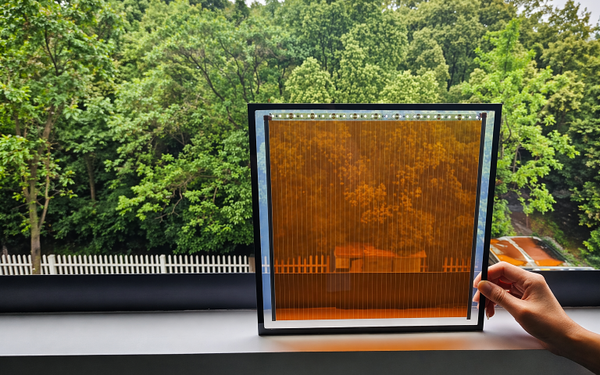
Image: UCL
The technology, described in a paper in Advanced Energy Materials, could help to turn buildings into power generators at night and on cloudy days as well as during sunshine.
The researchers engineered solar windows that let in 30% of sunlight – ordinary glass might let in 80% or 90% – while generating a record amount of energy from indoor light as well as efficiently harvesting energy from sunshine.
Senior author Dr Mojtaba Abdi-Jalebi, at the UCL Institute for Materials Discovery, said:
Rooftops are commonly fitted with solar panels but the vast window areas of many modern buildings remain largely untapped as an energy resource.
In our study, we showed it is possible to keep the window transparent so it can let light through while maintaining the solar cells’ efficiency.
The next step is to engineer flexible solar cells that can be applied to curved structures like windows on the Shard or on cars as well as non-rigid surfaces such as clothes or backpacks. We would also like to build solar cells over larger scales than we achieved in this study.
The longer-term vision is to make semi-transparent photovoltaics as easy to integrate as a window film. As the technology matures, these devices could potentially be developed into flexible films that can be applied directly on to vehicle glass, sunroofs, and other transparent surfaces to generate clean electricity without major structural changes.
Lead author Siming Huang, a PhD student at UCL’s Institute for Materials Discovery, said:
Another advantage of this technology is that by obscuring some of the sunlight it acts in the same way as tinted windows, saving a portion of the energy required to keep the building cool. This is especially important in hotter areas of the world that use a high proportion of energy on air conditioning.
The team used a material called perovskite which is increasingly used in outdoor solar panels and, unlike traditional silicon-based solar panels, has potential to generate energy from indoor light as its composition can be adjusted to better absorb indoor light’s specific wavelengths.
They used computer modelling to determine the best arrangement and thickness of layers in the solar cell for preserving both transparency and efficiency.
Based on this modelling, they engineered a perovskite layer – the layer that absorbs light – that was 185 nanometres thick (about 500 times thinner than a human hair). In typical solar cells the layer of perovskite is three or four times thicker.
They added a molecule (3-trifluoromethyl-1H-1,2,4-triazole) that reduced defects in the perovskite known as “traps”, which can cause electrons to get stuck before their energy can be harnessed. This molecule also helped stabilise the perovskite crystal structure, preventing degradation over time.
Semi-transparent solar cells that could be added to windows to efficiently harvest energy from indoor light as well as the sun have been developed by an international team led by UCL researchers.
The technology, described in a paper in Advanced Energy Materials, could help to turn buildings into power generators at night and on cloudy days as well as during sunshine.
The researchers engineered solar windows that let in 30% of sunlight – ordinary glass might let in 80% or 90% – while generating a record amount of energy from indoor light as well as efficiently harvesting energy from sunshine.
Senior author Dr Mojtaba Abdi-Jalebi, at the UCL Institute for Materials Discovery, said: “Rooftops are commonly fitted with solar panels but the vast window areas of many modern buildings remain largely untapped as an energy resource.
“In our study, we showed it is possible to keep the window transparent so it can let light through while maintaining the solar cells’ efficiency.
“The next step is to engineer flexible solar cells that can be applied to curved structures like windows on the Shard or on cars as well as non-rigid surfaces such as clothes or backpacks. We would also like to build solar cells over larger scales than we achieved in this study.
“The longer-term vision is to make semi-transparent photovoltaics as easy to integrate as a window film. As the technology matures, these devices could potentially be developed into flexible films that can be applied directly on to vehicle glass, sunroofs, and other transparent surfaces to generate clean electricity without major structural changes.”
Lead author Siming Huang, a PhD student at UCL’s Institute for Materials Discovery, said: “Another advantage of this technology is that by obscuring some of the sunlight it acts in the same way as tinted windows, saving a portion of the energy required to keep the building cool. This is especially important in hotter areas of the world that use a high proportion of energy on air conditioning.”
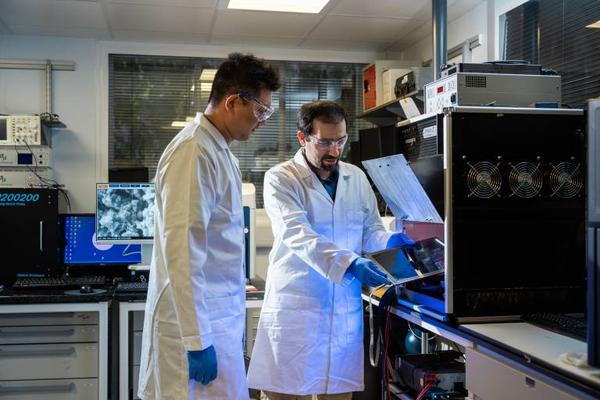
Siming Huang, left, and Mojtaba Abdi-Jalebi at work in the lab. Image: UCL
The team used a material called perovskite which is increasingly used in outdoor solar panels and, unlike traditional silicon-based solar panels, has potential to generate energy from indoor light as its composition can be adjusted to better absorb indoor light’s specific wavelengths.
They used computer modelling to determine the best arrangement and thickness of layers in the solar cell for preserving both transparency and efficiency.
Based on this modelling, they engineered a perovskite layer – the layer that absorbs light – that was 185 nanometres thick (about 500 times thinner than a human hair). In typical solar cells the layer of perovskite is three or four times thicker.
They added a molecule (3-trifluoromethyl-1H-1,2,4-triazole) that reduced defects in the perovskite known as “traps”, which can cause electrons to get stuck before their energy can be harnessed. This molecule also helped stabilise the perovskite crystal structure, preventing degradation over time.
In addition, the researchers engineered a transparent electrode. In perovskite solar cells, the electrode (i.e. the part that conducts electricity out of the cell) is typically made of gold and blocks light. To make their electrode more transparent, the team sandwiched a thin layer of gold between two transparent layers of molybdenum oxide, which helped light pass through the gold by reducing reflection.
The team fabricated a 30cm by 30cm panel, and found the solar cells could convert 22% of bright indoor light (1000 lux) into electricity, as well as 14% of sunlight. They found the bare device retained 80% of its efficiency over 300 hours of continuous exposure to light under a standard accelerated durability test, showing it was robust over time.
The work was supported by the Henry Royce Institute for Advanced Materials. The team received funding from the UK’s Engineering and Physical Sciences Research Council (EPSRC) and Department for Energy Security and Net Zero, as well as from UCL, the British Council and London South Bank University.
This article is from UCL